
Dance Me to the Edge of Hell

Updated: Mar 31

I grew up in a church that treated the world as mostly something to be avoided completely or approached cautiously, with protection, at a distance. Almost everything on Earth was tainted by the devil. The world was his dominion, we had to fight to rise above and say and do the right combination of things so that we wouldn't be sentenced to an eternity of torturous burning in a fiery pit.
We were the Assembly of God congregation, part of a denomination that had already fractured from its own origins. The early Pentecostal movement at Azusa Street, led by a Black preacher, William J. Seymour, had been radically integrated, spiritually ecstatic, and briefly unconcerned with the racial hierarchies of its time. But that openness did not hold. By the time the church of my upbringing came into being, the movement had splintered along familiar lines, and what remained felt narrower, more controlled, less interested in the spirit than in the boundaries that might contain it.
By the time I arrived on the scene, the rules were less about theology than about perimeter. The question was not what brought you closer to God, but what might expose you to everything else. Drinking was forbidden. Movies were forbidden, not only the vulgar ones, but the wholesome ones too, because they all came from the same corrupt source: Hollywood, a sordid manufacturing plant for temptation and sin. Music was treated with suspicion. Secular rock was outright banned, but even Christian rock carried a faint odor of compromise. Some in the church insisted the danger wasn’t the lyrics but the rhythm itself, tracing its origins to Africa and concluding, with a logic both confident and absurd, that the beat was the devil’s work.
And dancing. Dancing was not merely discouraged. It was categorically out of the question.
This baffled me at an early age. The Bible was full of dancing. Miriam danced after the Red Sea crossing. David danced before the ark. The Psalms and Ecclesiastes practically commanded it. But the church had a way of flattening contradiction into certainty. If they said no, then no became law.

Meanwhile, I was a boy who couldn’t stop moving.
At school, I hovered at the edges of things. I had a high, effeminate voice, too much feeling, too much imagination. Recess was not for games like “smear the queer,” but for worlds I constructed in my head, entire productions unfolding behind my eyes. I was present, technically, but never quite inside the moment. Always adjacent. Always watching myself from somewhere just outside.
At home, the script had already been written for me. Church. Sports. Cub scouts. Compliance. Rules. Role. I was enrolled in baseball, then basketball, activities chosen less for joy than for what they signaled. Masculinity. Normalcy. Safety.
I tried, at first. I really did. But as the balls came faster at me, my fear of injury grew with it. The crack of a bat sent a jolt through me, not excitement, but dread. In the outfield, though, there was a strange reprieve. Alone in left or right field, I could sing quietly to myself, a private rehearsal beneath the open sky, until the sudden terror of a ball arcing in my direction snapped me back into the game I never wanted to play.
I wanted something else entirely.
I discovered it the day I saw a high school production of Camelot. Musical theater. That was it. Not just singing and acting, but also movement to tell a story. Dance. It wasn’t decoration; it was elemental. It seemed to reach somewhere deeper than voice, deeper than words. Something primal. Something spiritual. Dance.
I begged my parents to let me take dance lessons.
No.
I pleaded again with more ammunition. Two of my female cousins closest to my age were taking dance lessons. I saw images. We went to a dance recital.*
Still no.
Instead, my mother handed me a pamphlet one afternoon. From the Dance Floor to Hell. On the cover, a ballroom floor tilted into a fiery abyss, couples slipping helplessly into flames. A cautionary tale rendered in lurid illustration.
Really? I remember thinking. Just for dancing?
The answer, as always, was yes.

I kept dancing anyway, just not really where they could see.
Except, eventually, they did.
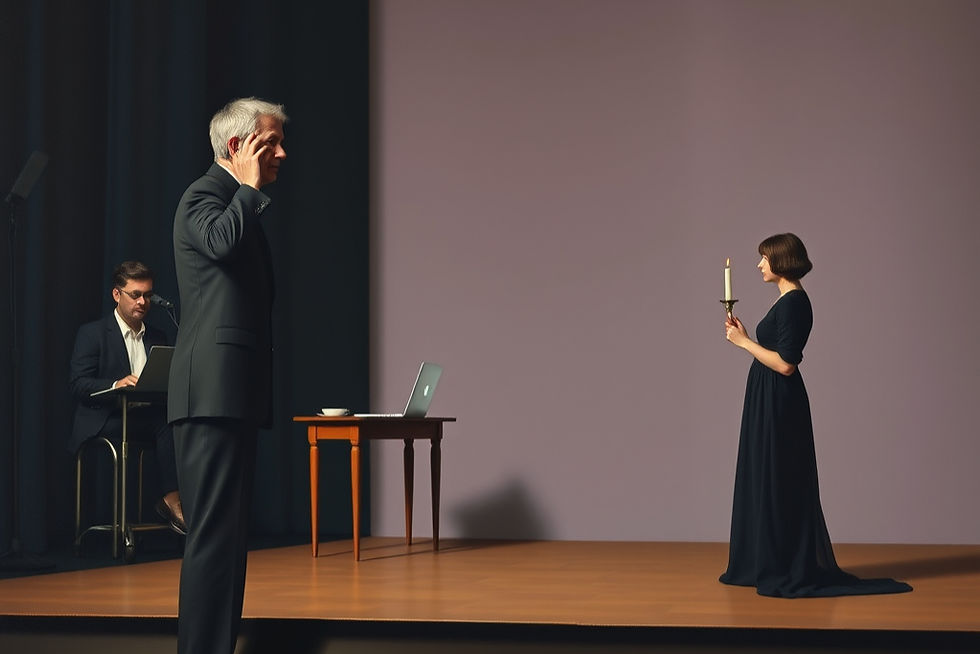
After one of our games, our team sponsored by McDonald’s, the adults gathered around a heap of equipment in the parking lot, I wandered across the street to a bandshell. An empty stage. Elevated, open, irresistible.
A stage is never just a stage. It is an invitation.
I stepped onto it and began.
The choreography came from everywhere: backyard routines, trampoline sequences, fragments of music I’d absorbed from discount cassette tapes. My arms stretched wide, claiming the space. I moved through it with a kind of instinctive certainty, as if my body knew something my life did not.
For a moment, I wasn’t outside of things.
I was the thing itself.
Then my mother’s voice abruptly cut through the routine running in my head.
“C. J. Wilson! What do you think you're doing?”
I turned. Parents were watching. Teammates. A younger brother pointing me out like an exhibit. The words came quickly: disgraceful. Unmasculine. Un sportsmanlike. An embarrassment...to the team, my parents, my brother, but mostly, myself.
And then the heat.
Shame arrived all at once, flooding my body, tightening my chest, pulling me abruptly back into myself. I became aware, painfully aware, of how I looked, how I was being seen. The dance collapsed under the weight of their gaze.
But beneath the shame, there was something else.
Recognition.
Someone had noticed.
Not as appreciation. Not as understanding. But as observation. I had been seen, not as a person, but as a spectacle.
And that, I would come to understand later, changes everything.
Because once you know you are being watched, you begin to split. There is the self that moves, and the self that monitors the movement. The performer and the audience collapse into one body. You no longer simply are: you appear.
Years later, reading Guy Debord, I would recognize that moment on the bandshell as my initiation into the spectacle. Not the grand, media-saturated spectacle of modern life, but its most intimate form: the awareness that existence itself can become performance under the gaze of others.
Debord wrote that everything once directly lived becomes representation.
I had lived something true on that stage, something immediate, unmediated. But the moment it was seen, it was no longer mine. It became an image, judged, categorized, rejected.
And so I learned, slowly, to retreat.
Or rather, to perform differently.
To edit myself. To anticipate the gaze. To live not from impulse, but from awareness of how impulse might be received. A quieter kind of choreography, one shaped not by music, but by surveillance.
But even then, especially then, the urge remained.
Because somewhere underneath the watching, underneath the shame, underneath the careful construction of a self that could pass without comment, there was still that boy on the empty stage.
Arms outstretched.
Certain, for a moment, that he was exactly where he was meant to be.
March 21, 2026
* I had friends over last night to watch the beloved American classic movie musical, Singin in the Rain. They were also raised in the Assembly of God church, and had never seen the film.
G. mentioned that Central Assembly, the largest AG church in Boise, now relocated and rebranded, didn’t believe in hell. It probably was a joke, but it stuck with me. Because it suggested something I’ve circled for years: that proximity to Boise seemed to soften the edges of belief. The rules didn’t disappear, but they loosened. The perimeter widened.
My cousin’s family attended Meridian Assembly of God, just outside Boise. She was enrolled in dance for a season before my aunt felt convicted and pulled her out. Conviction, in those circles, had a way of arriving suddenly and with authority.
And yet, there were other inconsistencies. My aunt and uncle went to the movies. Not just safe, anodyne fare, but Rated R films. As a kid, this felt both scandalous and exhilarating. There was an avenue for less restrictive living.
I remember one weekday night when our church group piled into cars to see a traveling theatrical performance at Central Assembly. There was dancing in it. Actual dancing. This felt destabilizing. I tracked down the pastor’s wife, the organizer of the carpool, and asked her what to make of it.
Her answer was precise, almost clinical: dancing was acceptable if it honored God, and only God. The moment it called attention to the body, to the individual, it crossed a line. It became something else.
Which is to say: the rules were never just rules. They were negotiations. Interpretations. Quiet contradictions, lived out in real time.
So, it's probably time.
The next post will have to reckon with hell.


Comments