
The Friday America Becomes Bartleby


There is something quietly absurd about the Friday before Memorial Day. It is not quite a workday, and not quite a holiday; it is a performance of the former staged in full knowledge that everyone has already spiritually departed for the latter.
Thursday evening, I watched it happen in real time. Around the final hour of the workday, our office began sounding less like a functioning workplace and more like a building shutting itself down for the season. Drawers slammed. Chairs rolled backward. People called out "have a good weekend!" with the emotional urgency of freed prisoners. Summer itself seemed to be entering the building through the exits everyone else was rushing toward.
It had become clear that only two of us from the department would be returning Friday morning: myself and one other. The rest of the team and the company at large had mentally checked out until Tuesday.
Walking across the emptying parking lot, I had the uncomfortable sensation that I was participating in something ceremonial rather than necessary, a ritual whose meaning had long since evaporated, leaving only the form behind.
What kind of schmuck voluntarily shows up for a sham workday?
And immediately after thinking this, I realized I was probably part of the problem.
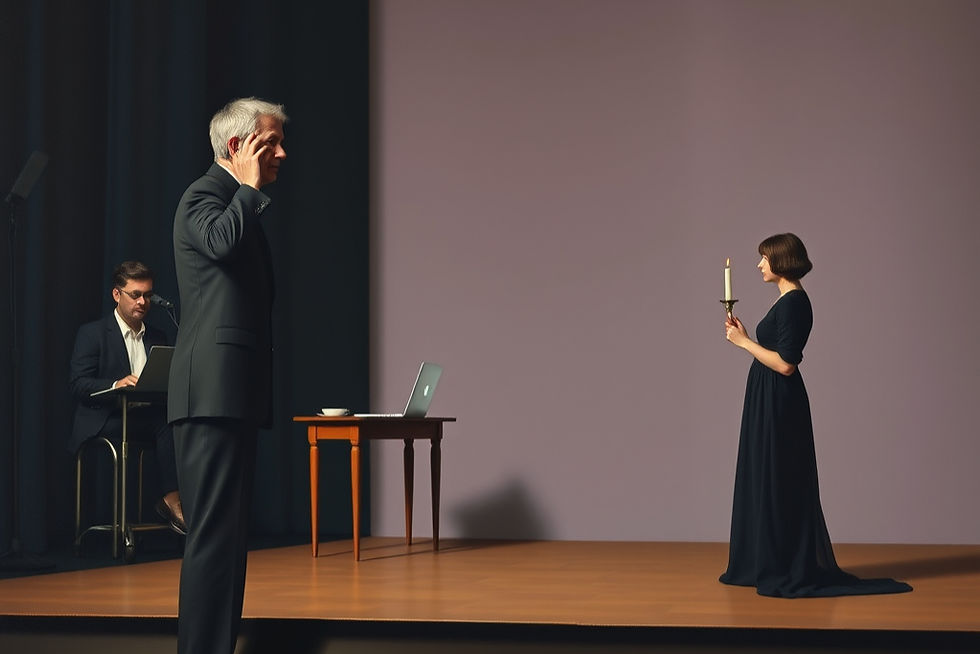
Friday morning, across America, offices are filled with people who have mastered the art of occupational theater. The problem is in the pretending, the collective, exhausting maintenance of a performance that fools absolutely no one, least of all the performers.
Which brings to mind Herman Melville's Bartleby, the Scrivener, perhaps the most quietly devastating portrait of office life ever written.
"I would prefer not to."
Perhaps the most honest sentence in all of American literature. Bartleby remains haunting because he functions simultaneously as an inspirational hero and a cautionary tale. He recognizes the absurdity and emptiness embedded within mechanical office life and, simply, not dramatically, not politically, but with a devastating softness, withdraws his consent from it.
Every Friday before Memorial Day, America becomes Bartleby. We maintain the outward forms of productivity while privately acknowledging that almost nobody believes meaningful work is occurring. Ritualized busyness. A collective agreement to keep Outlook calendars technically operational while the nation emotionally drifts toward a weekend escape.
Last night, I mentioned this to two friends, a schoolteacher and a mortician, both raised in the Assembly of God church, as I was. That last detail feels strangely relevant. Pentecostalism leaves many of us with a lingering, low-grade suspicion that rest itself might constitute a moral failure. Leisure always feels faintly incriminating, something requiring justification before both society and God. You must earn your ease. You must be seen earning it.
Death does not observe holiday weekends, so the mortician was working on Friday. The teacher said she'd probably be able to leave around noon. Since our school days, we have known this day is already functionally dead. Why not formalize the truth?
The case for making the Friday before Memorial Day a federal holiday is not, at its core, a radical argument. It is simply an argument for institutional honesty.
The evidence is no longer ambiguous. Studies on shortened workweeks have been accumulating for years now, and they keep arriving at the same uncomfortable conclusion: fewer hours often produce better outcomes. Four-day workweek trials conducted across multiple countries and industries — from Microsoft Japan to the governments of Iceland and the United Kingdom — have consistently shown higher employee morale, lower rates of burnout, improved retention, and productivity that is equal to or greater than that of the traditional five-day model.
Human cognition does not improve through endless extension. Unlike factory labor, most modern office work is not a function of hours logged — it is a function of attention, creativity, and engagement, all of which degrade sharply as exhaustion compounds. After a certain point, additional hours stop producing value and begin producing resentment, distraction, errors, and meetings nobody wanted in the first place. The Friday before Memorial Day is perhaps the clearest annual demonstration of that truth, writ large across an entire country.
Nobody sincerely believes this is a critical productivity day. We simply continue staging the performance because institutions are profoundly uncomfortable admitting that some rituals have outlived their meaning, and because there are always people like me, showing up out of some residual sense of duty, quietly perpetuating the fiction by our presence.
There is a subtle moral vanity in still showing up. A little Protestant martyr complex. A quiet internal narration: Well, somebody around here is still working. I have been that person. I am probably that person still.
But Bartleby exposes the fragility of that logic. He forces us to ask whether some forms of labor persist not because they remain necessary, but because we have collectively forgotten how to stop performing them, because the performance itself has become the point.
Melville refuses to make Bartleby a victorious revolutionary. His withdrawal eventually curdles into isolation and despair. Total disengagement becomes its own kind of destruction. He is a warning, not a model.
But arguing for a four-day weekend once a year is not withdrawal from society. It is not Bartleby's quiet, fatal refusal. It is something more modest and more honest: an acknowledgment that the workday has already ended, and that we should stop pretending otherwise.
Give people the day officially. Call the country's bluff. Let the offices empty with dignity instead of stealth. Let the green dots on Microsoft Teams go dark without ceremony or apology.
And spare the remaining few the performance before an audience of no one, from the growing suspicion that we may have fundamentally misunderstood what adulthood was supposed to look like.
The holiday already exists. We simply haven't had the honesty to name it.


Comments