
“O/Q”: A Semiotic Study in Holiday Mutation and Ontological Whimsy

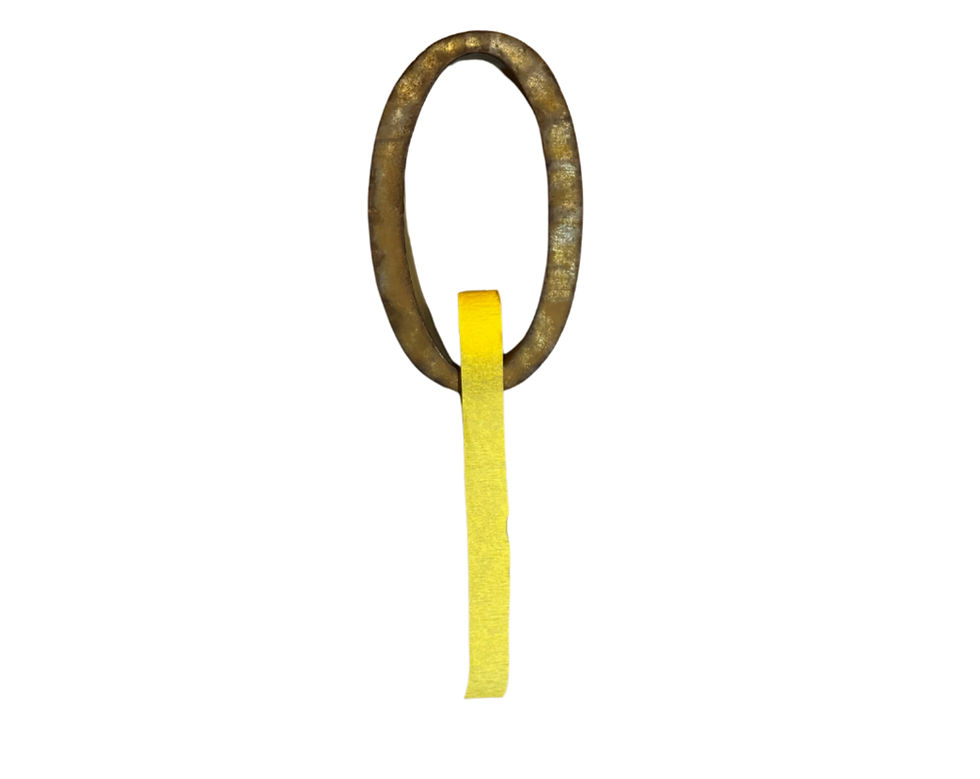
One hesitates, naturally, before pronouncing a found object as art, especially when its ambition is announced so brazenly by its humility. Yet there it hangs, a distressed metal “O” rescued from the fluorescent graveyard of a thrift store, reanimated by the merest strip of yellow party streamer. A circle becomes a question. “O” becomes “Q.” In the slightest intervention, the sacred vowel of exclamation is penetrated by inquiry.
At first glance, the piece seems to mock the very concept of transformation. The O, with its oxidized patina, bears the aspect of antiquity, an artifact of signage, of words, of language once useful. The yellow streamer, flimsy and festive, flutters absurdly against this metal relic. The gesture is so simple it borders on insolent: a Dadaist prank disguised as Christmas décor. And yet, within this linguistic sleight of hand lies a profound (if accidental) metaphysics.
The Semiotics of the O
In the lexicon of symbols, the O is an origin, void, wholeness, eternity. It is the circle of halo, host, and wreath alike. In my personal mythology, “O” has become shorthand for Christmas, echoing the opening of countless carols: O Holy Night; O Come, O Emmanuel; O Little Town of Bethlehem. Each invocation begins not with a noun but with wonder and yearning, an O that signals both awe and absence. It is zero and infinity at once. To see it rendered in cold metal is to witness reverence ossified into ornament.
The Intervention of the Q
Enter the streamer. Cheap, cheerful, and unabashedly non-eternal, it slashes the circle open, appending a tail that drags divinity down to earth. The O becomes Q, a symbol of interrogation, of quest, of the inquirer who refuses to let mystery remain sealed. What had been pure devotion becomes a dialogue.
Semiotically speaking, the work performs what Barthes might call a “second-order signification”: the sign (O) is appropriated and displaced by a new system of meaning (Q). The festive flash of yellow represents the color of candlelight and illumination. But now the streamer ironically functions as both a desecration of the sacred O, and a renovated symbol of inquiry and revelation.
“O” represents the inherited music of belief, the carols sung in unanimity, the certainty of communal melody. The introduction of the streamer is a heretical flourish: a ribbon of doubt, uncoiling from the circle’s throat. Where once there was the obedient vowel of praise, now there is the consonantal consonance of questioning. The O’s pure vowel has acquired a tail and become curiously animalistic.
As a readymade, the piece participates in Duchamp’s lineage, an act of artistic designation that turns banality into ontology. But unlike Duchamp’s "fountain," which declared itself R. Mutt, this work remains anonymous, humble, as though the thrift store itself had performed the transubstantiation. The artist here is merely acting as the midwife of meaning, the facilitator of a shift from ornament to oracle.
The distressed metal, with its bruised gleam, speaks of endurance and repetition, the eternal return of the holiday cycle, the exhaustion of ritual. The streamer, in contrast, insists on the momentary: it will fade, tear, fall. The whole composition thus stages a dialogue between permanence and perishability, faith and festivity, sanctity and parody.
Toward a Symbolic Synthesis
Let us risk one final symmetry: if O is the symbol of Christmas, the circle of divine completeness, then Q is the aftermath, the questioning that follows belief, an existential trajectory that buries wonder under layers of criticism.
The yellow streamer flutters up and looks like a tongue, wagging from the mouth of the O, mocking both reverence and rebellion. It laughs gently at its own inflated profundity, knowing full well that in the end, all our artistic epiphanies are just thrift-store miracles: cheap, luminous, and fleeting.



Comments